 Ronald's Scribblings
Posts
-
Marina Barrage and the Floods
I don’t know about you, but my uneducated and uninformed hunch tells me that the flooding in recent days is not solely caused by the weather—it is too convenient an excuse to use. Something else must have a hand in it.
Referring to this picture found on the PUB Marina Barrage web site (click to enlarge):
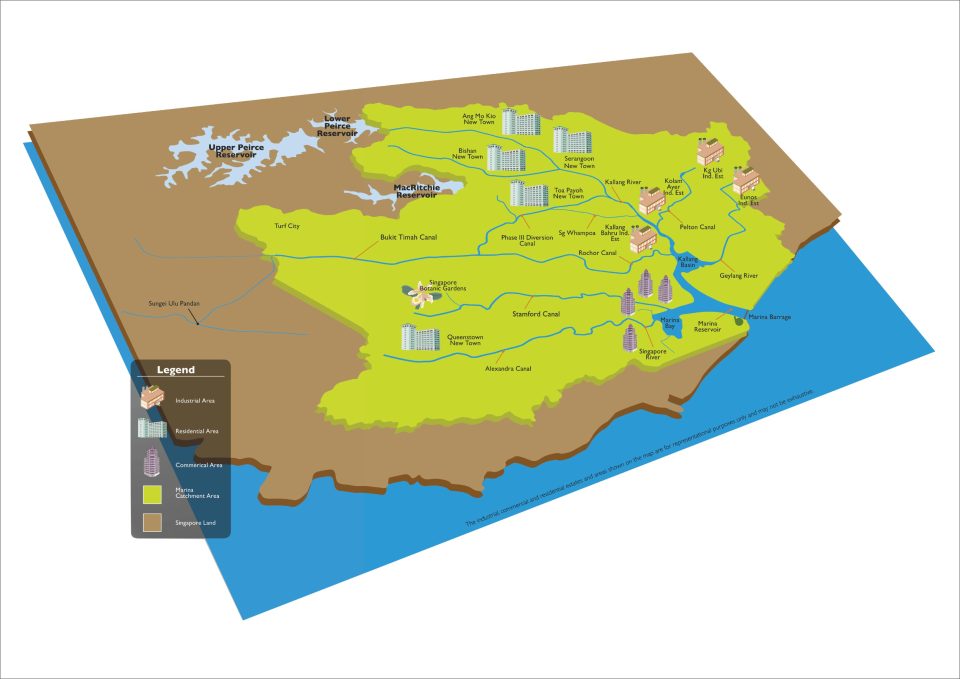
The image shows the enlarged catchment area after Marina Barrage is brought online.
I recall seeing another graphic at the Marina Barrage visitor information panels that shows the water catchment areas in Singapore before the construction and completion of Marina Barrage. I cannot find the image anywhere, but I’m very sure that Singapore is split into a few zones where each major reservoir has a designated catchment area surrounding it.
Of particular interest, the areas which began flooding right after the Marina Barrage came online were those that were new to the enlarged catchment zone.
I suspect that the rise in the water-table, caused by the Marina Barrage’s purpose of enlarging the water catchment area, coupled with intensive underground works, i.e., KPE, Circle Line, Downtown Line, contributed to the increase in flooding incidents within the recent year. Adding to that, they must have also lacked plans to increase drainage capacity to address issues as raised above.
Honestly, I am willing to accept any form of flooding (due to unusual weather conditions) as long as the infrastructure is designed to support it and will gracefully degrade to provide limited service.
· · · -
Touchable Windows 8
Summarising John Gruber in his post, “Why Windows 8 Is Fundamentally Flawed as a Response to the iPad”:
Apple’s radical notion is that touchscreen personal computers should make severely different tradeoffs than traditional computers — and that you can’t design one system that does it all. Windows 8 is trying to have it all, and I don’t think that can be done. You can’t make something conceptually lightweight if it’s carrying 25 years of Windows baggage.
Jared Newman disagrees by claiming that a Tablet being all-in-one, with both the new Windows 8 interface and the old windows interface integrated, will be more successful:
What Microsoft demonstrated on Wednesday is exactly what I want in a computer — a lightweight tablet UI that’s meant for casual computing and a powerful, classic Windows that allows me to work.
I disagree with Newman on this count as his premise is untenable: “There will be demand for touch-based apps simply because of how many people are already using Windows.”
Just because you are a Windows user does not mean that you will use the new Touch UI add-on as the classic Windows interface is still available. There is a tendency for people to fall back to familiar grounds, despite new improvements that could be had in learning and employing new technology.
Furthermore, why would anyone use the new Touch UI interface when there are hardly any applications written for it? While Newman claims that “Microsoft has proven willing to grow its app ecosystem by paying developers” (as seen in Windows Phone 7), that doesn’t explain why 3rd-party applications on WP7 are still lacking in quality and quantity—What app would you use for GPS running, SSH, VNC, Tweeting, Facebook or Things?
So really, creating an ecosystem isn’t as simple as paying a few developers to port their stuff and leaving a legacy interface behind for “compatibility reasons”. Microsoft hasn’t succeeded, but Apple has. Windows 7 will just be another Windows 7 with its new Touch UI relegated to an “Apple Dashboard-like” position in the OS.
· · · -
Things, OmniFocus, and The Hit List
For the past 3 years, I’ve been a using Things for Mac together with Things for iPhone companion app for managing my day-to-day tasks. In the past year, I’m starting to find the development pace of Things to be a little too slow for my tolerance.
The desktop application has a few serious short-falls (inflexibilities) that really limit the way one can organise tasks. For example, there isn’t a way to order sequential tasks except by creating a project. You can’t nest projects, neither can you arrange them as though they are tasks. From the way the company, CultureCode, functions, it seems unlikely that they will be rethinking the architecture of Things any time soon.
Another annoying thing about Things is that their sync solution between the desktop, iPhone, and iPad applications is extremely cumbersome. It requires the desktop application to be the gatekeeper and sync-hub of all other mobile devices, which is impractical in this day and age. Imposing such requirements to ensure data integrity (data loss do occur!) across three devices is ridiculous and renders the mobile devices useless once either of them have been out-of-sync. Their solution to this problem, in the form of Cloud Sync, has been in the works for almost 2 whole years! I’m finding it hard to justify waiting any further when competing products are beginning to surface, namely, OmniFocus and The Hit List.
For a moment in time, I did give OmniFocus a spin and found it overly complex, cluttered and ugly. I loved the clean look of Things and would not like to give it up unless I really had to. Over the Air (OTA) sync is one of them. Furthermore, OmniFocus mobile companion products, for both the iPhone and iPad, are sold separately and are rather expensive. Then, I decided that it’s best that I give OmniFocus a miss and to remain with Things.
Two years ago, The Hit List (THL) was in beta and it came with the 2009 MacHeist bundle. It was a little buggy and in public beta then, but it looked promising. Development suddenly stopped in 2009 and their last blog post was dated September 2009. Nothing was heard nor written about THL since then, leaving many to believe that the developers have given up.
Then, on 1st June 2011, literally out of the blue, THL’s Twitter account sprang to life and announced that THL 1.0 is released. The iPhone companion app has also been submitted to Apple for review. Life seem to have been injected into the project and THL has since seen its second bugfix release. With the license key from the MacHeist bundle, I decided to give THL another try as I have already paid for it, more than 2 years ago.
My first impression of my second trial of THL was a reminder of how similar it is to OmniFocus. I’m inclined to see THL as a lighter and leaner sibling of OmniFocus. Given that OTA sync is already delivered out of the box (albeit at $20/year), and that the iPhone app is currently being reviewed by Apple, THL has already offered more functionality than Things and its companion app combined. Furthremore, THL has a cleaner interface compared to OmniFocus and its single-character keyboard shortcuts are a plus.
Now that the summer holidays are here, and that my task load is a lot lower, any task manager migration, if any, must be done before the start of my school term. After evaluating THL as a Things replacement, I decided to take the plunge and to migrate over to THL from Things completely, after ensuring THL’s feature parity with Things.
So, to Things, I bid farewell.
· · · -
Thoughts on Apple's pre-WWDC Announcement
This morning, I woke up to a rather curious and surprising announcement, directly from Apple itself, regarding the contents of WWDC keynote:
At the keynote, Apple will unveil its next generation software - Lion, the eighth major release of Mac OS® X; iOS 5, the next version of Apple’s advanced mobile operating system which powers the iPad®, iPhone® and iPod touch®; and iCloud®, Apple’s upcoming cloud services offering.
There can be multiple reasons for doing so, but one thing that is certain is that this is a first time that Apple pre-announces the content of their keynotes.
While I would not know their true intentions, I have three suspicions for them doing so.
First, set the tone for the rumour mills to follow, reducing wild speculations that lead to unnecessarily high false expectations, which severely affects their stock and reviews when they are not, and are not meant to be met.
In some of their previous Keynotes, analysts have remarked that they are underwhelming. Truth be told, these expectations were possibly set by rumours mills and could be unrealistic as Apple never speculates nor comment on their future plans. By pre-announcing what Apple will talk about, it gives rumour mills some degree of scope and restrain from speculating too far, keeping consumer expectations in check, leaving them with a prime target—iCloud.
Secondly, it could just be technically impossible to launch an iCloud service “live” during the Keynote without making preparations that can be seen by outsiders, like changing domain ownership. By pre-announcing, Apple refocuses their “wow” strategy of the keynote on possibility of the iCloud service rather than the fact that Apple is to launch the iCloud service.
Thirdly, this allows Apple to set the stage most aptly for an “Oh, one more thing” announcement.
Then, as if to fan the rumours of a Keynote that’s too content overloaded, Apple released another press release on new versions of iWork on the same day, a few hours later:
Apple® today announced that its groundbreaking iWork® productivity apps, Keynote®, Pages® and Numbers®, are now available for iPhone® and iPod touch®, as well as iPad®.
On the day of the keynote, you would know how the rumour mills were being steered.
· · ·